
01 / Measuring now
Follow the response.
Measure when chemical features shift after exposure, starting with our melanoma-cell pilot.
Follow how living-cell chemistry
changes under treatment.
Biology has been doing forensics.
We're making film.
Why time matters
A final measurement can miss when change began and what changed first. Cell Cinema follows chemical change across space and time.
Label-free chemical imaging follows living cells over time.
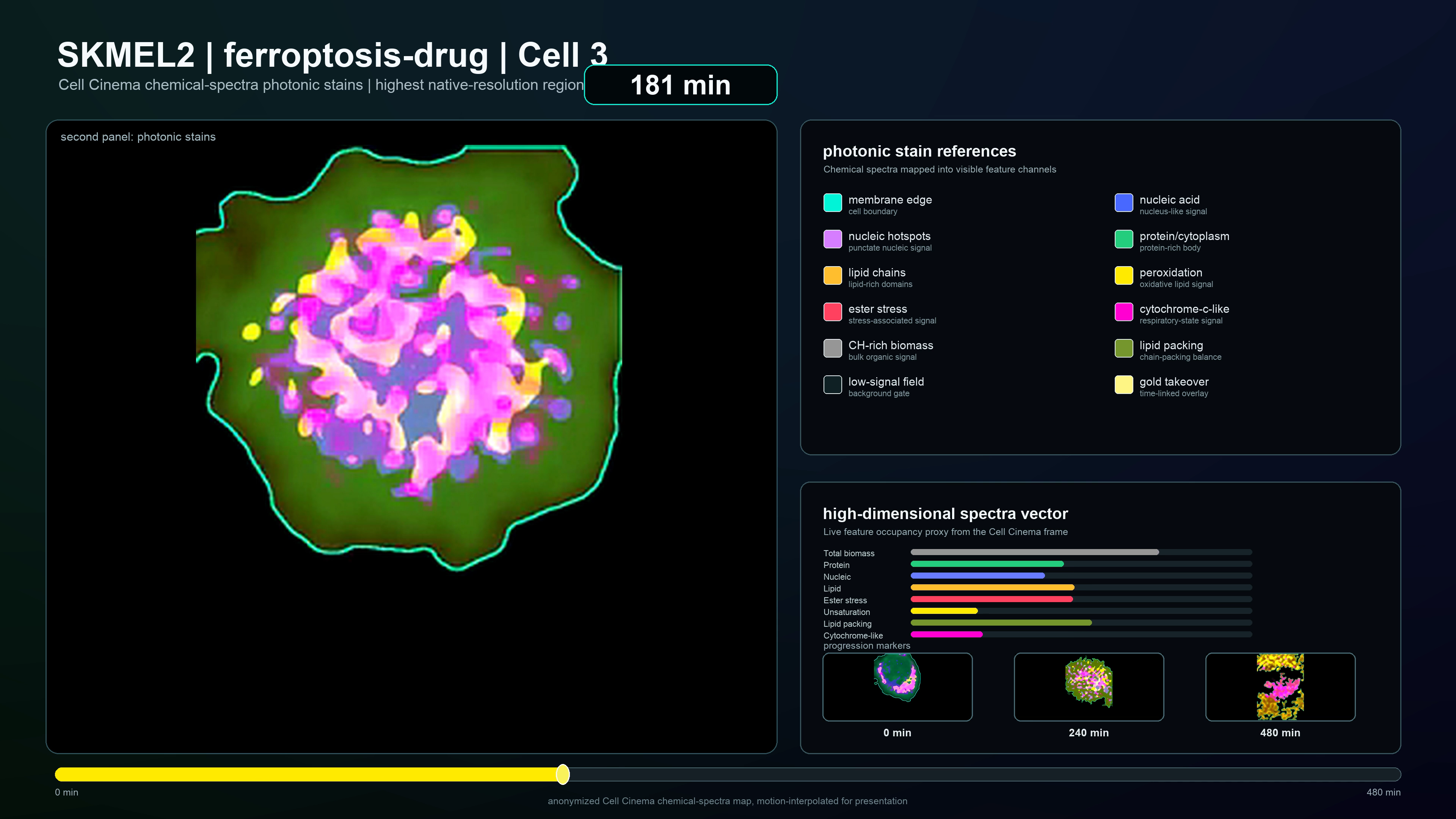
Movie colors represent processed spectral-feature classes, not validated organelles. Display frames are interpolated. The video is silent.
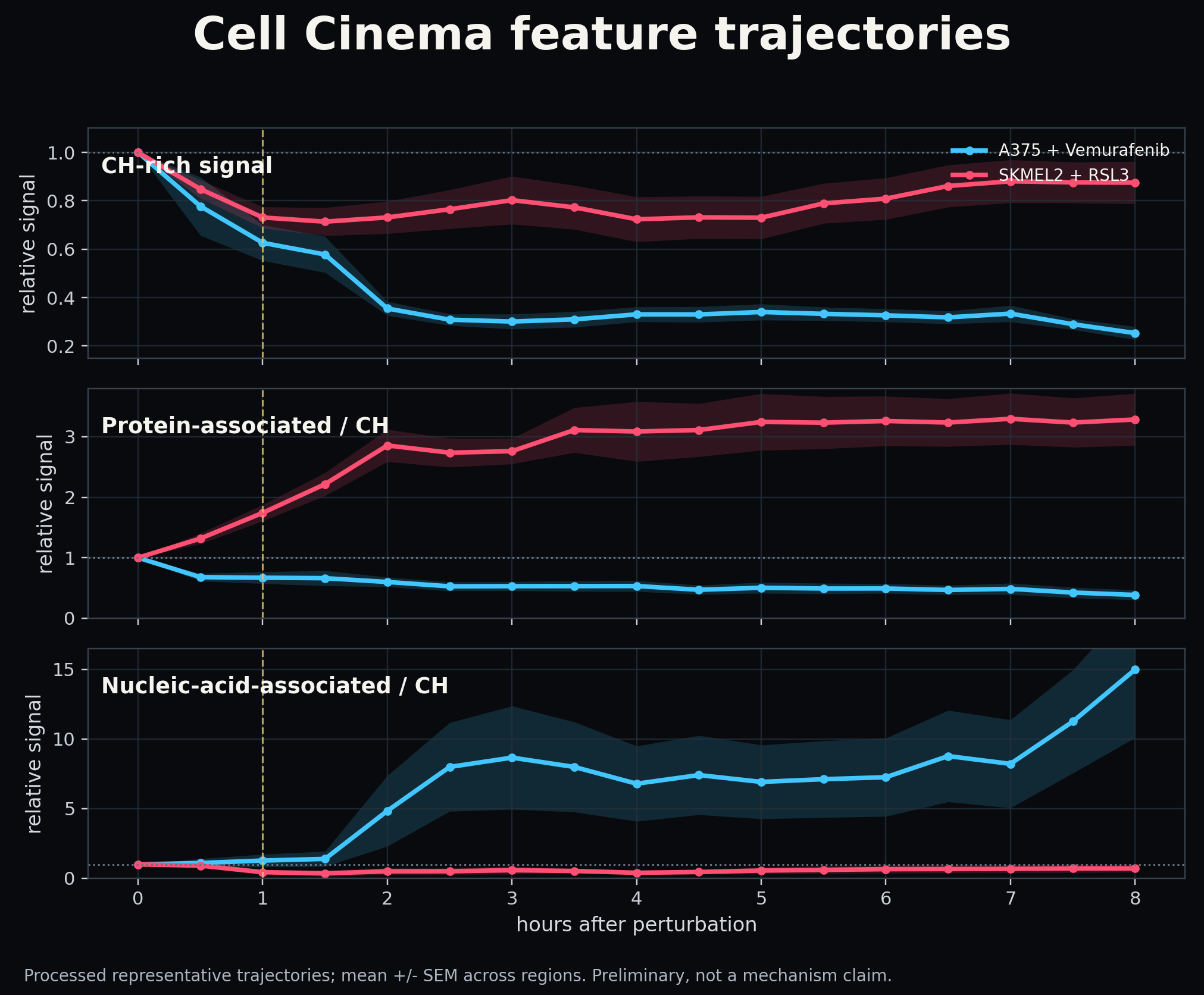
Plots show representative processed trajectories, with mean ± SEM across regions. Protein-associated signal relative to CH rises in SK-MEL-2 + RSL3 and falls in A375 + vemurafenib. Both cell model and treatment differ, so this comparison does not isolate a treatment effect. Feature ratios describe relative signals; they do not establish mechanism, viability, or cell fate.
View the full-size plotThe platform and the purpose
Models of cellular change need observations of how cells respond. Cell Cinema records chemical features with treatment, location, and time.
Measurement
Map label-free chemical features and their spatial organization after treatment.
Acquired observations
Connection
Connect measurements with treatment, location, and time to follow the sequence of change.
Chemical trajectories
Research direction
Use response histories to develop models of cellular change and test their predictions against later measurements.
Model development and evaluation
The research question: Can earlier observations help predict a later measured response?
Cell Cinema combines label-free chemical imaging with repeated observation of the same living cells. The result is a record of chemical features, their spatial organization, and how they change over time.
Map spectral features within living cells to connect changes in chemistry with where those changes occur.
Measure native vibrational-spectral features without fluorescent labels. Processed feature maps reveal patterns to investigate with complementary biological assays.
Repeat measurements of the same living cells to follow the timing, direction, and persistence of chemical-feature changes after a perturbation.
Our near-term focus / Toxicity
Our next step is to test whether early changes in living-cell chemistry can anticipate later toxicity readouts—and help focus the next experiment.
01 / Measuring now
Measure when chemical features shift after exposure, starting with our melanoma-cell pilot.
02 / Next validation step
Pair early trajectories with independent viability and toxicity measurements.
03 / Build toward
Evaluate candidate signals across compounds and controls to learn whether they can inform earlier compound triage.
Medium-term goal
Bring controlled experiments, repeated chemical measurement, and analysis into one repeatable workflow.
The goal: comparable response histories across compounds, doses, and cell models, supporting drug-response research and virtual-cell models.
Explore the hardware platformFor pharma, biotech, and AI research teams
Explore a focused study of how living cells respond to a perturbation. We’ll define the experiment and analysis around the question you need to answer.
Discuss a studyA closer look
The measurement, the public evidence, and where a collaboration could begin.
The public Cell Cinema preview includes processed movies, an explanation of the measurement approach, scientific references, and evaluation criteria. Examples follow SK-MEL-2 melanoma cells under RSL3 treatment and A375 melanoma cells after vemurafenib treatment.
Open the technical previewA trajectory connects a cell’s earlier state to its later response. That history lets researchers ask when changes appear and how responses differ across cells, alongside the information available from an endpoint measurement.
See how a cell-state record is builtObserved drug-response trajectories can provide data for developing and evaluating models of cellular behavior. The test is whether a model can predict later responses on held-out experiments. The preview does not establish predictive accuracy or clinical utility.
Read the evaluation criteriaTell us about your cell model, the perturbation you want to study, and the decision or research question you want to inform. We can discuss the experimental fit, relevant readouts, and how an evaluation could be designed.
Start a research conversationUpdates on research, milestones, and strategic insights from our team
Featured · Technology
Watch live-cell chemical movies and explore how label-free imaging follows the same living cells over time, providing observed perturbation-response trajectories for virtual-cell models.
Explore Cell Cinema
Drug Discovery News features Precigenetics and Cell Cinema in a piece on the field's shift away from destructive endpoint assays toward continuous, label-free measurement of living cells.

R&D World profiles Precigenetics and our work building real-time chemical movies of living cells, and the case for a measurement step-change in drug discovery.

How repeated chemical measurements of living cells can connect cellular changes over time and support drug-response research.