Precigenetics

Cell Cinema technical preview

A Tokenizer for Living Cell State

Cell Cinema is a label-free 3D hyperspectral and volumetric imaging system for training AI on living cell dynamics.

Precigenetics exists to change what is measured so AI can interact with life in real time.

Cells are dynamical systems, but most high-dimensional cell datasets are collections of snapshots. A cell is fixed, lysed, or selectively labeled; its next state is measured in a different cell. The response path must be inferred after identity has been lost.

Cell Cinema changes the data type. It repeatedly measures native chemical organization across the same living cell in 3D, before, during, and after perturbation. Each observation becomes a high-dimensional state vector. The sequence is a cell-state trajectory.

This first public preview follows drug-induced ferroptosis through processed spatial chemical measurements and shows how those measurements become the model-facing record: one cell, one identity, many states through time.

Change the measurement → change what AI can do.

Living biology same living cell
not lysed, fixed, or averaged away
chemistry + space + time
context + perturbation
stress, adaptation, toxicity, recovery
Cell Cinema measures and encodes
Cell token zt = Eθ(S0:t, c) a high-dimensional vector of live cell state
Models learn transitions
Computable biology Dψ(zt, p, τ) → ẑt+τ predict response
search trajectories
choose next experiment
learn rescue paths
model human drug-cell response

Tokenizer S0:t, c → zt ∈ Rd / Trajectory z0:T = (z0, ..., zT) / Transition Dψ(zt, p, τ) → ẑt+τ

Representative processed Cell Cinema movie: a public visual preview of live cell-state token construction.
What the words mean 3D. Native. Alive. Identity-preserved.
VOLUMETRIC

State with depth.

Rather than a single focal plane or flat projection, the measurement retains x, y, and z. Structure through depth becomes part of zt.

LABEL-FREE

No compounding assay tax.

Acquisition is not free, but each new timepoint does not require another dye, antibody, genetic reporter, or sacrificed aliquot. More observations do not require a new labeling stack.

REAL-TIME

Mechanism in motion.

The response is measured while the cell is alive. Onset, compensation, adaptation, injury, and recovery become observed events rather than a path reconstructed after fixation or lysis.

SAME-CELL

One identity. One path.

One living cell contributes z0:T. Change is measured within the same biological unit instead of inferred across different cells.

Living Biology, Packaged

The artifact, the machine, and the signal.

MBOP is the sealed experiment package. LUMA is the scale-out acquisition system. Cell Cinema is the living-state signal that becomes z0:T.

Conceptual 3D visualization of a sealed MBOP cartridge inside a LUMA observatory producing Cell Cinema token trajectories
Conceptual visualization. Internal geometry is intentionally nonrepresentative and not to scale. The package is MBOP. The system is LUMA. The output is living-state trajectories.

The frontier

The missing layer is live biological measurement.

The hardest bottleneck is not molecule generation alone. It is learning what living human-relevant cells do under perturbation before those failures appear in people.

"Imaging living cells without killing them would be revolutionary."

Hassabis framed the gap as a measurement problem: if living cell dynamics could be observed without destroying the cell, biology could become a visual learning problem for AI.

Demis Hassabis, YC conversation with Garry Tan, 2026
"There are no existing AI/ML systems that mitigate clinical failure risks due to target choice or toxicology."

Lowe's point lands at the exact place drug discovery still fails: target choice, toxicology, and the lack of predictive live biological evidence.

Derek Lowe, In the Pipeline, Science

This is the frontier Cell Cinema is built to finally break: live cell response as a model-native data object.

The task AI cannot do

Give AI a diseased cell and ask what moves it toward recovery.

Today, it cannot answer that in the way biology needs. It can generate molecules, predict protein structures, read text, and classify images. But it does not have a native input for a living cell changing under perturbation.

Most high-dimensional cell-state measurements are destructive or terminal. RNA-seq is powerful. Fixed imaging is powerful. Endpoint toxicity assays are useful. But they often tell us where a cell ended, not how it moved.

The path is the biology: when stress began, whether the cell adapted, whether injury reversed, whether toxicity was silent before it became visible, and which perturbation moved the cell back toward health.

The missing input is the identity-preserved sequence: one living cell measured before, during, and after perturbation.

Diagram showing disease response encoded as Cell Cinema token trajectories for AI
Disease response as token movement. Cell Cinema encodes the same living cell through time so models can learn response paths rather than terminal labels alone.

The representation

From repeated measurement to model-native state.

At each timepoint, the Cell Cinema tokenizer produces zt: a compact vector of the observable chemical-spatial state of one living cell under known experimental context. The same cell then contributes z0:T, preserving a response history that a terminal assay cannot contain.

Operational, not metaphysical zt is not asserted to be complete molecular ground truth. It is a useful state representation if similar live states encode similarly and biologically different states separate.
Identity before compression Token construction begins only after cell identity, spatial organization, acquisition context, and time have been retained.
History when state is partial No single-timepoint Markov assumption is required. A model may condition on the observed token history, perturbation history, dose, and environment.
Prediction is the criterion The representation earns the name only if it supports retrieval, forecasting, and generalization on held-out cells, runs, and perturbations.
Diagram of Cell Cinema converting live cell feature maps into a high-dimensional cell-state token
The tokenization interface: repeated chemical-spatial observations are converted into high-dimensional state vectors; vectors from the same living cell form a trajectory.
Diagram of the Cell Cinema record as a cells by time by features tensor
A Cell Cinema dataset is naturally a cells-by-time-by-features tensor. The key is that the same cell contributes repeated tokens, so AI can learn direction, speed, divergence, and recovery.
Diagram of Cell Cinema vector tokens moving through latent cell-state space after perturbation
Perturbation becomes geometry: Cell Cinema measures how high-dimensional live-cell tokens move through state space, including same-cell trajectories and mean perturbation displacement.
Flow diagram showing nondestructive, spatial, predictive, and perturbable token construction
Token construction principles. A useful cell-state token preserves the same living unit, spatial organization, predictive history, and response under perturbation.

First experiments

The first few Cell Cinema experiments.

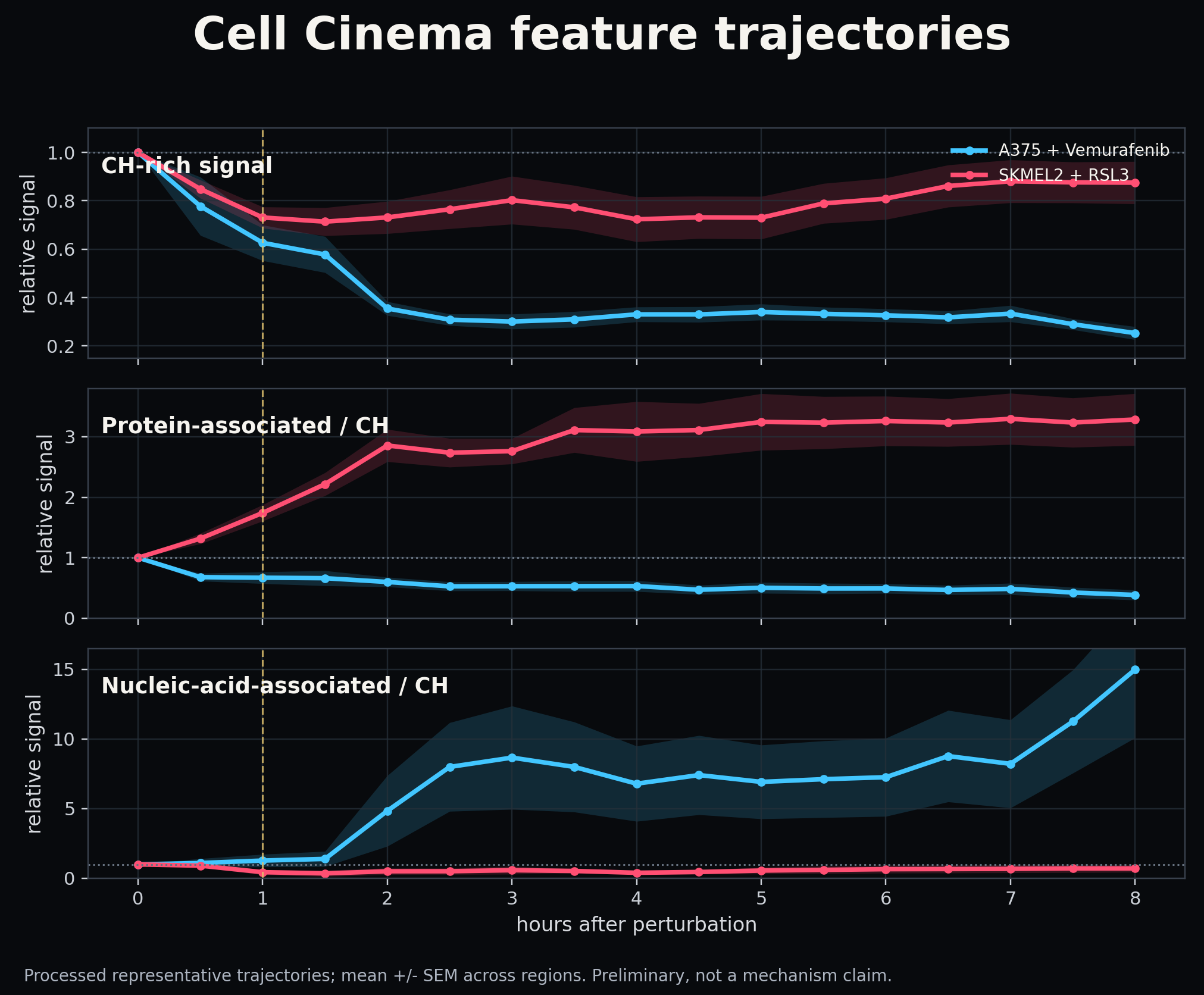
These first experiments follow RSL3-induced ferroptotic stress in SKMEL2 melanoma cells and vemurafenib response in A375 melanoma cells. The videos show representative processed, label-free spatial chemical measurements across time: changing feature maps for human inspection and the same observations encoded as time-indexed cell-state vectors and trajectories.

Processed representative renderings of live chemical feature maps. Pseudolabel colors are visualization classes, not antibody labels or validated organelle segmentation.
A human-readable projection of token construction: the processed feature map, selected vector components, and time-indexed state of the same cell.

Watching ferroptosis unfold

RSL3 is a compound used to trigger ferroptosis, an iron-dependent form of cell death, by inhibiting GPX4 and weakening the cell's defense against lipid oxidation. Here, Cell Cinema follows SK-MEL-2 melanoma cells as that response develops through time.

Mechanistic anchor: RSL3 is an established ferroptosis inducer whose canonical target is GPX4. Yang et al., Cell (2014).

Watching melanoma respond to targeted therapy

Vemurafenib is a targeted therapy that inhibits mutant BRAF signaling in melanoma. Here, Cell Cinema follows A375 melanoma cells as their chemical state changes after treatment.

Clinical anchor: vemurafenib is an FDA-approved kinase inhibitor for unresectable or metastatic melanoma with a BRAF V600E mutation. FDA prescribing information.

One experiment pushes cells toward ferroptotic death. The other applies a targeted melanoma therapy. Cell Cinema measures how those different biological responses unfold, rather than only where the cells end.

Endpoint biology

perturb wait destroy / fix endpoint infer path

Tokenized live biology

z0 perturb z1, z2, z3... observed path predict next state

The hardware platform

Precigenetics is building a hardware platform for biology.

Software agents work because computers expose state, actions, memory, and feedback. A biological agent needs an equivalent physical interface: maintain living systems in controlled context, deliver perturbations as actions, repeatedly measure response, and preserve outcomes through time.

Label-free vibrational-spectral measurements expose native cellular chemistry, but the observation is inseparable from its environment. Temperature, media, flow, dose timing, optical calibration, and microphysiology all change the state being encoded.

Precigenetics therefore treats the experiment as part of the interface. Incubation and controlled perturbation move onto the chip. Human-relevant microphysiology becomes part of the measurement context. Cell Cinema is the observation layer, returning repeated chemical-spatial state from the living system.

MBOP is the chip direction. Cleopatra is the toxicity foundation-model direction trained on liver-chip trajectory data. Together, the aim is a reproducible industrial system for producing the data object AI drug discovery does not yet have: live cell-state trajectories.

Precigenetics holds IP around this measurement and microfluidic data-factory approach. The thesis is trajectory recovery: HMCVelo showed that temporal motion can be inferred from static epigenomic snapshots; Cell Cinema removes the static constraint by measuring living response directly. The direction is 3D, tissue-facing, and built for human-relevant systems.

"Every cell carries, in the chemical modifications of its DNA, a continuous record of where it has been and a set of instructions for where it is going. To read this record directly — rather than through the downstream proxies of gene expression — is to observe differentiation at its point of origin."
Parmita Mishra, HMC Velo author and founder of Precigenetics

Scaling laws require manufactured measurements.

How this changes AI

The learning problem is conditional trajectory prediction.

Given an early same-cell history, perturbation, dose, elapsed time, and biological context, predict the distribution of future states and outcomes. The model may use the entire observed history; Cell Cinema does not assume that one partially observed token is Markovian or that one deterministic future exists.

Agent loop: observe z0:t → choose perturbation p → wait τ → measure zt+τ → update the model → choose the next experiment. This is not AI simulating biology in isolation. It is AI learning from an instrumented living system.

Diagram of Cell Cinema high-dimensional vectors powering autonomous biology
A closed-loop biological agent needs a physical feedback channel. Cell Cinema returns the result of each action as a high-dimensional token trajectory from living cells.
Representation learning Train embeddings on tokenized cell histories instead of only static cell images or terminal molecular snapshots.
Trajectory retrieval Search for cells, drugs, doses, or contexts whose token sequences move through similar response paths.
Early-warning prediction Ask whether stress, adaptation, toxicity, or recovery is visible in token movement before an endpoint assay reports a label.
Autonomous biology Close the loop: observe token history, select a perturbation, measure the outcome, update the policy, and choose the next experiment.

The hardware is the environment. The token is the observation. The perturbation is the action. The trajectory is the memory.

Response as geometry

Disease response is movement through state space.

A cancer cell moves toward resistance, death, persistence, or rescue. A liver cell moves through compensation, stress, injury, or repair. An immune cell moves through activation, exhaustion, suppression, or recovery. Once live response is represented as token sequences, those movements become geometry: distance, direction, curvature, onset, divergence, reversibility, and neighborhood structure.

Processed Cell Cinema feature trajectories
Processed feature trajectories. Preliminary and hypothesis-generating; shown as views of token construction and trajectory geometry.
Cell Cinema trajectory embedding
A trajectory-space view from processed vibrational-spectral feature vectors.
Trajectory surprisal relative to early baseline
One way to ask whether later states remain close to the early baseline, shown here as a visual proof-of-concept for trajectory scoring.

Scaling law

Breaking the biological scaling law, Moore-style.

The old frontier forced biology to choose: deep but destructive, live but shallow, or high-throughput but endpoint-only. Cell Cinema is built to move the frontier: more live observability per experiment, lower cost per useful cell-hour, and repeated timepoints on the same living unit.

Moore-style graph showing Cell Cinema breaking the old depth versus throughput frontier
Breaking the old tradeoff. The goal is not simply more endpoints; it is live, deep, nondestructive, high-throughput biological observation.
Destructive endpoint design C × P × D × R × T Contexts, perturbations, doses, replicates, and timepoints all multiply sample burden.
Live trajectory design C × P × D × R Timepoints become repeated observations on the same living unit.
Cell Cinema The tokenizer: live chemical measurements converted into zt.
MBOP Future manufactured experiment layer for controlled perturbation contexts.
LUMA Future screening-factory path for repeatable token acquisition.
Cleopatra Prediction systems trained on trajectory tokens for toxicity and biosafety.
Atlas The corpus: standardized token trajectories across context, perturbation, dose, and outcome.

Precigenetics is building a tokenizer for living biology: a way to convert live cellular chemistry into high-dimensional state vectors that can be scaled into perturbation-response atlases.

Endpoint Cell Cinema feature shifts
Endpoint panels can be useful sparse anchors for live token trajectories. They are not same-cell movies unless the same living cells are followed through time.

Human drug-cell response

Clinical trials should not be where we first learn what a drug does to living human cells.

The long-term goal is to stop discovering obvious drug-cell response failures for the first time in humans. Before a drug reaches a patient, we should be able to ask how living human-relevant cells move under that perturbation: liver cells, tumor cells, immune cells, cardiac cells, vascular cells, and combinations of them.

1. Hardware and acquisition releases More reproducible, controlled, and scalable live-cell token measurement.
2. Token engineering Feature extraction, quality control, embedding stability, schema design, and representation learning.
3. Human-relevant complexity Moving from early examples toward higher-complexity systems, including toxicity-relevant liver contexts.
4. Data engineering and atlases A growing corpus of cell-token trajectories across perturbations, doses, contexts, anchors, and outcomes.
5. Toxicity and biosafety prediction Systems trained on trajectory tokens rather than static endpoints.

Safety and reliability

Live-cell capability should scale with safeguards.

Toxicity and biosafety are natural first applications because the path matters. A cell does not become stressed, compensated, adapted, injured, or recovered as a single label. It moves through those states.

Private pilots are underway with organizations that will be announced separately. These programs are evaluating whether live trajectory measurements improve toxicity, biosafety, and perturbation-response decisions under controlled access and predefined reliability gates.

This regulatory position is already public. In Precigenetics' submitted FDA docket comment on New Approach Methodologies, we argue that integrated NAM systems should be evaluated as measurement methods: by context of use, technical characterization, longitudinal same-sample evidence, modular validation, and fit-for-purpose weight of evidence. Read the FDA NAMs public comment.

Toxicity prediction Use live trajectories to detect stress, compensation, recovery, or failure earlier than endpoint-only assays.
Biosafety readouts Measure unfamiliar or out-of-distribution perturbation responses as living trajectories, not just terminal effects.
Controlled access Keep raw acquisition files, proprietary metadata, platform implementation, and partner-specific records behind appropriate boundaries.
Reliability gates Scale claims only when reproducibility, model lift, earliness, anchor alignment, and cost per useful cell-hour are demonstrated.

Evaluation discipline

Falsifiable, or it does not count.

The test is direct: if early token trajectories z0:k do not improve held-out disease-response prediction over endpoint-only baselines, the cell-token hypothesis fails.

QuestionEvaluationFailure condition
Token stabilityCompare technical replicates, runs, and matched biological states after calibration.Run effects dominate biological effects.
Early predictionForecast later stress, recovery, or failure from an early prefix of the same-cell trajectory.No lift over a single frame or endpoint baseline.
Trajectory retrievalRetrieve related perturbations and response classes while holding out compounds and runs.Nearest neighbors reflect batch rather than biology.
Context transferMeasure generalization across cell backgrounds, doses, environments, and acquisition days.The representation collapses outside its training context.
Anchor alignmentAlign live trajectories with sparse molecular or phenotypic endpoints without treating anchors as the trajectory itself.Token motion is unrelated to independent biological anchors.
Sample efficiencyCompare prediction quality at matched numbers of destructive anchors and experimental cell-hours.Longitudinal measurement provides no information advantage.

Context

Where this sits in the field.

Cell Cinema is aimed at a complementary layer for virtual-cell and multimodal atlas efforts: live, label-free, vibrational-spectral trajectories from the same cells over time.

  1. Bunne et al., "How to build the virtual cell with artificial intelligence: Priorities and opportunities," Cell, 2024. doi.org/10.1016/j.cell.2024.11.015
  2. Dibaeinia, Babu, Knudson et al., "Virtual Cells Need Context, Not Just Scale," bioRxiv, 2026. doi.org/10.64898/2026.02.04.703804
  3. Aevermann, Califano, Chiu et al., "A path towards AI-scale, interoperable biological data," arXiv, 2025. arxiv.org/abs/2510.09757
  4. Liu, Leonetti et al., "A multimodal perturbation atlas defines the phenotypic resolution of cellular morphology," bioRxiv, 2026. doi.org/10.64898/2026.06.01.728087
  5. Zhang et al., "Tahoe-100M: A Giga-Scale Single-Cell Perturbation Atlas for Context-Dependent Gene Function and Cellular Modeling," bioRxiv, 2025. doi.org/10.1101/2025.02.20.639398
  6. Mishra, "HMCVelo: A Deterministic Model for Hydroxymethylation Velocity in Single Cells," bioRxiv, 2026. doi.org/10.64898/2026.04.20.719607 · bioRxiv v1 · PDF
  7. Weinreb, Wolock, Tusi, Socolovsky, and Klein, "Fundamental limits on dynamic inference from single-cell snapshots," PNAS, 2018. doi.org/10.1073/pnas.1714723115
  8. Qian, Dong, and Guo, "Grow AI virtual cells: three data pillars and closed-loop learning," Cell Research, 2025. doi.org/10.1038/s41422-025-01101-y
  9. Garcia Martin et al., "Perspectives for self-driving labs in synthetic biology," Current Opinion in Biotechnology, 2023. doi.org/10.1016/j.copbio.2022.102881
  10. Hershberg, "What Are Virtual Cells?," The Century of Biology. centuryofbio.com/p/virtual-cell
  11. Hassabis and Tan, "How to Build the Future: Demis Hassabis," Y Combinator, 2026. ycombinator.com/library/P3-how-to-build-the-future-demis-hassabis
  12. Lowe, "AI and the Hard Stuff," In the Pipeline, Science, 2023. science.org/content/blog-post/ai-and-hard-stuff
  13. Foster, "You cannot understand biology by killing it," Drug Discovery News, 2026. drugdiscoverynews.com/you-cannot-understand-biology-by-killing-it-17159
  14. Buntz, "Why the techbio Precigenetics aims to swap cell 'autopsies' with live-cell measurement," Research & Development World, 2026. rdworldonline.com/why-the-techbio-precigenetics-aims-to-swap-cell-autopsies-with-live-cell-measurement
  15. Precigenetics, "Public Comment, Docket No. FDA-2025-D-6131: Draft Guidance for Industry: General Considerations for the Use of New Approach Methodologies in Drug Development," submitted to FDA, 2026. precigenetics.ai/documents/precigenetics-fda-public-comment-nams-2026.pdf

Closing

The road from cell tokens to human drug-response prediction.

Which cells compensate? Which enter silent stress? Which recover? Which fail? Which dose moves a diseased state toward health without pushing another human cell type toward toxicity?

Those are trajectory questions. They need a native unit of living cell state: a high-dimensional vector that can be measured before, during, and after perturbation; a vector that preserves chemistry, context, and time; a vector that can be composed into trajectories and scaled into atlases.

Drug Discovery News captured the measurement thesis directly: "You cannot understand biology by killing it." Cell Cinema is built around that boundary: follow the same living unit, keep the trajectory, then give AI the token.

R&D World framed the same break from endpoint biology as swapping cell "autopsies" for live-cell measurement. The consequence is a different kind of biological record: state, context, perturbation, and outcome joined by identity through time.

Cell Cinema begins with measurement. Tokenization makes the measurement composable. Trajectories make it predictive. Manufactured acquisition makes it scalable. The long-term target is biological AI that can ask not only what a molecule binds, but what a living human cell will do next and which intervention changes that path.

Measure the state. Preserve the path. Learn the intervention.